
Law, Ethics and News Literacy
Understanding press law and news literacy is crucial for any journalist. My understanding is evident in my work, and I work to convey these ideas to my staff members.
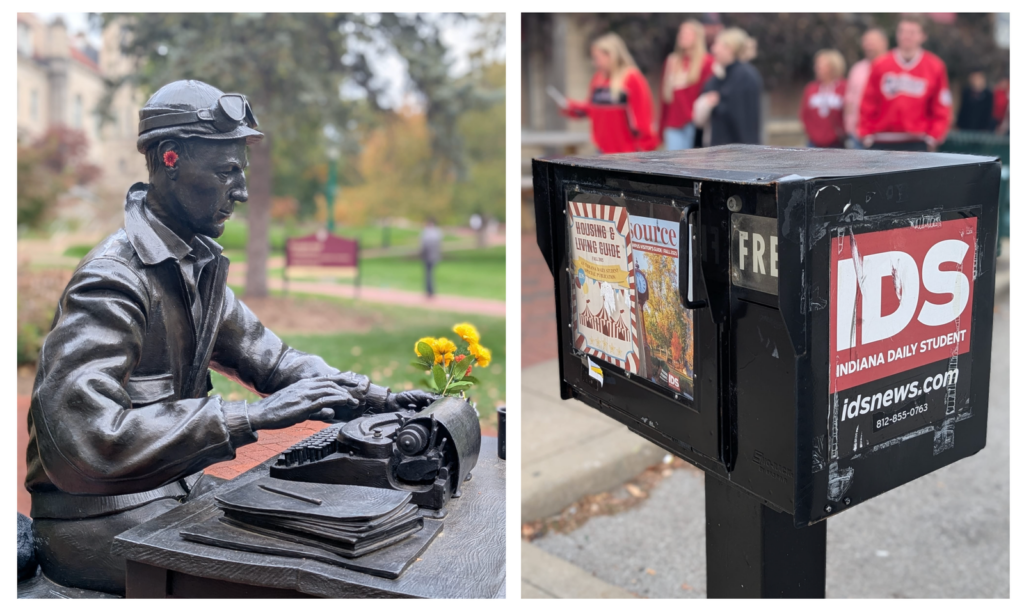
Indiana Daily Student adviser’s firing sparks legal fight, faculty rebuke, new IU task force
Oct. 26, 2025
This article covered Indiana University’s incident with the Indiana Daily Student in October: the university’s questionable demand, the student media director’s termination, and the elimination of all print editions. This piece demonstrates my understanding of student media, not only at the high school level but at the collegiate level: governing bodies, censorship, student media finances,
I interviewed the fired student media director, a co-editor-in-chief of the paper, and retired faculty. I also provided important context, including a relevant student media plan that was barely a year old, the costs and deficits faced by the organization, and comparisons to student media at other U.S. universities and colleges. My article also broke the news that the fired director planned to sue the university for wrongful termination.
I proposed covering this topic to my editor because I felt like a stakeholder of sorts. I’m also in a position where my work could be censored. I am applying to colleges, including IU. As I told a fellow student reporter in Oregon who interviewed me for an opinion piece he wrote on the topic, this hyperlocal event paralleled many others like it around the U.S., and its impacts are sure to affect me.
Yearbook Staff Handbook
This is the staff handbook I wrote, largely from scratch, for the yearbook program after my first semester as Editor-in-Chief.
Over the summer in 2024, I wrote this and worked with our advisers to refine it, using the knowledge I’d collected up to that point. Then, prior to the 2025-26 school year, I met with our returning staffers to edit and revise this based on what we observed and the ideas we had. Together, we updated and added sections, and changed what didn’t work the year prior.
This resource for the staff provides clear guidelines and rules when it comes to responsibilities and expectations, journalistic ethics, social media, and business considerations. While a document like this, and collecting student signatures, can be seen as a formality, our handbook and code of ethics detail our values as an organization, and serves as a decision-making guide.
School District Student Media Policy
My school corporation, the Monroe County Community School Corporation (MCCSC), currently has a restrictive student media policy that allows prior review and content decisions by school administrators. This policy contrasts MCCSC’s former policy, which established student journalists’ First Amendment rights in the context of school-sponsored student publications. (The current policy came from Neola, a company that provides school corporations with packets. It was adopted by the school board in 2013.)
As a student appointed to the MCCSC Superintendents’ Student Voice Advisory Council, I am currently working with district administrators to pass a board policy to establish school-sponsored publications as an open public forum. This would empower students to make the final call when it comes to publications, and legally protect MCCSC employees and allow students to learn journalistic integrity and ethics in an environment that more closely reflects the real world (though it seems like the free press is increasingly under attack at levels far above student journalism). It’s difficult for me to tell students that they can write and publish what they think is best when prior review is possible.
I’m hopeful that I can effectively collaborate with school leaders and the school board to pass a new policy that better supports student media at the schools in our district.